Great design feels obvious after you see it. But getting there is a game of rules, not magic. The 12 principles of design are the toolkit designers use to make visuals feel clean, readable, and satisfying.
If you create anything visual, logos, merch, YouTube thumbnails, social posts, or brand assets, these principles will level you up fast. You’ll learn how to guide attention, create contrast, keep things balanced, and make your work feel intentional instead of accidental.
Let’s break them down, and put them to work.
What are the principles of design?
The principles of design are fundamental concepts that guide the arrangement and organization of elements in a visual composition.
The elements of design, including line, shape, color, texture, and space, form the basic visual components of any artwork or design.
It’s crucial to keep consistency when using each design element especially when you manage social media accounts, as this helps create a cohesive brand identity and makes your content instantly recognizable to your followers across different platforms from Instagram to email marketing campaigns.
But it’s the principles of design that make these elements work together to create a cohesive, interesting, and compelling design.
Why are the principles of design important?
The principles of design are the rules that turn “stuff on a page” into visual communication. They help you make choices that feel intentional, not accidental. When you understand them, you gain a shared vocabulary for why a design works, why it fails, and how to fix it.
Here’s why they matter:
- They bring structure. Principles like alignment, hierarchy, and proximity help viewers scan, understand, and navigate fast.
- They create harmony. Balance, repetition, and unity make a composition feel stable, cohesive, and polished.
- They guide attention. Contrast and emphasis tell the viewer what matters first, second, and last.
- They create motion and flow. Rhythm, pattern, and movement lead the eye through a design, so it feels alive, not static.
- They strengthen the message. Every principle supports clarity. When the structure is right, the meaning lands faster, and the design feels more trustworthy.
The 12 principles of design
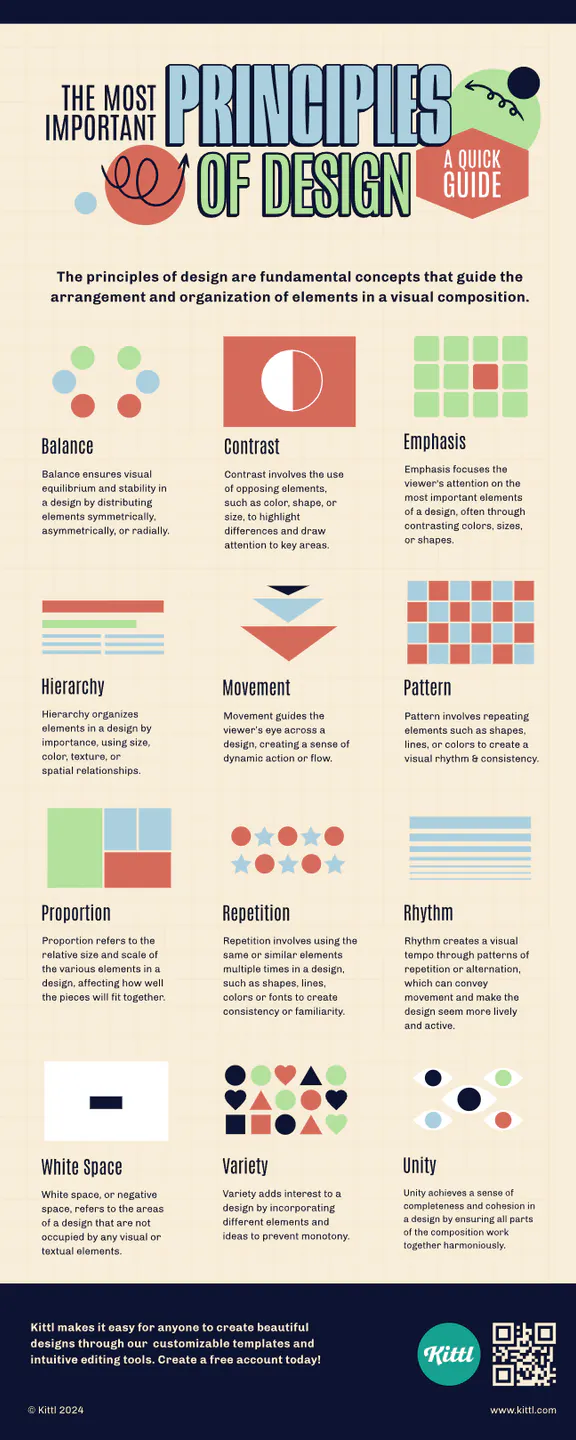
The principles of design are sometimes called the “rules” of design. However, these rules aren’t set in stone. You have the freedom to use and interpret them in your unique way.
Here are the 12 design principles:
Principles of design #1: Balance
Balance is how visual weight is distributed in a design. It can be symmetrical (evenly mirrored) or asymmetrical (different elements that still feel stable). Strong balance creates calm and clarity. Intentional imbalance can create tension, energy, and focus.
Why is it important?
Balance makes a design feel steady and believable. When a layout is balanced, your viewer can read it without friction. When it’s unbalanced, the eye gets pulled too hard in one direction, unless that pull is the point.
How to apply balance
- Start with a focal point. Decide what should carry the most weight.
- Check the “left vs. right” feel. If one side feels heavier, adjust size, spacing, or contrast.
- Use symmetry for trust. Great for logos, badges, formal brands, and anything that needs stability.
- Use asymmetry for energy. Balance a large object with smaller items, whitespace, or stronger contrast.
- Zoom out or blur-test. If one corner shouts louder than everything else, rebalance.

The image of a golden dragonfly at the center of the other elements is a perfect example of symmetrical balance.
The dragonfly is vertically symmetrical, and the placement of the decorative stars is positioned to achieve a mirrored look from left to right.
Furthermore, the text elements, including the main title, “Spirit,” are evenly spaced on both sides of the image, creating a sense of equilibrium.
Your artwork doesn’t require perfect symmetry to achieve balance. Here’s an example of a social media template for “Back to School” using asymmetrical balance.
Although the image on the left is much larger than the one on the right, the space, black border, and the text below the smaller image help distribute the visual weight evenly. Using this design can lead to more efficient and streamlined social media management platforms.

Principles of design #2: Contrast
Contrast is how you make elements feel different enough to stand apart. You can create contrast through color, size, weight, shape, texture, spacing, or type style. Good contrast makes a design easier to read, more memorable, and more focused.
Why is it important?
Contrast is what makes your design say something. It helps key details pop, guides the viewer to the focal point. Custom Pins can use contrasting colors, shapes, outlines, and finishes to make logos or messages stand out. This translates design elements into physical pins while preserving the original visual hierarchy for branded merchandise, events, and recognition items.
The sweet spot matters: too much contrast can feel chaotic, while too little can feel flat and forgettable.
How to apply contrast
- Pick one main contrast lever. Start with size, color, or type weight. Don’t max out everything at once.
- Use contrast to build hierarchy. Make the most important element the most distinct.
- Pair opposites on purpose. Bold vs. light, geometric vs. organic, sharp vs. rounded, matte vs. metallic.
- Test in grayscale. If it still reads in black-and-white, your contrast is doing real work.
- Keep contrast consistent. Repeat your contrast rules across a logo kit so it feels intentional.

This landscaping logo uses tone colors to achieve a clean and modern look with its blue and beige background, enhancing readability and recognition.
The top image features darker colors against a light background for strong contrast. The bottom image contrasts the organic, humanist style of a heavy font and the lighter, geometric sans serif fonts.

Principles of design #3: Emphasis
Emphasis helps highlight specific parts or areas in a design. You can achieve this by using differences in size, color, contrast, or placement of elements. This principle helps create a hierarchy and guide the viewer’s eye.
Why is it important?
Emphasis allows you to highlight key information or messages in your design, making them stand out and grab the viewer’s attention. Without it, your design may lack a clear focal point and appear cluttered.
How to apply?
This t-shirt design effectively uses emphasis to highlight the key message “Fearless,” which is accompanied by a skull illustration with red fire-like accents. The other elements are kept minimal, drawing attention to the emphasized word and image.

The poster below, which resembles a cartoon drawing, highlights the words “Wander” and “Lost” using a different font style and color. The same color was also applied to the man walking toward the sun to emphasize the message of being on an adventure.

Principles of design #4: Hierarchy
Hierarchy refers to the organization and emphasis of elements within a design. It helps to create a clear structure and guide the viewer’s eye through the design, starting with the most important information.
Why is it important?
A clear hierarchy allows viewers to quickly understand and navigate through your design, making it more effective in communicating its intended message or purpose. Without hierarchy, a design can feel chaotic and confusing.
How to apply?
A simple way to apply hierarchy is by using a clean design layout with a clear visual hierarchy. In this drink menu design for a cafe, the layout is organized in a clear waterfall-like structure, with the best-seller items placed at the top, followed by the other menus in descending order.

Here’s another example of hierarchy in a job opening poster.
The words “We’re Hiring” are big and bold, immediately catching the viewer’s attention. Then, it guides the reader’s eyes toward the job opportunity, and lastly, it includes a call to action, telling those interested to “join our creative team.”

Principles of design #5: Movement
Movement guides the viewer’s eye through a design using lines, shapes, and the placing of elements. This principle helps add a sense of dynamism and energy to a design.
Why is it important?
Creating movement in a design allows you to control how the viewer perceives and interacts with it. It also helps to develop a sense of action and lead the viewer’s eye to essential elements.
How to apply?
This poster is about a live jazz music concert that cleverly used the saxophone to create movement and lead the viewer’s eye toward the concert’s title. Then, the effects around the concert title give the design a sense of movement and energy.

In this other concert event poster, the distortion effect on the fonts and lines adds movement to the design, giving it a 70s vibe.

Principles of design #6: Pattern
Patterns involve the repetition of various design elements to establish a cohesive theme in your design, helping improve the viewer’s overall experience. Patterns can be created by combining shapes, colors, textures, or other design elements.
Why is it important?
Patterns can add visual interest and texture to a design, elevating it from plain and boring to captivating and engaging. By tying together different elements, they also help create a cohesive look throughout the design.
How to apply?
This minimalist design for New Year’s wishes uses different shapes to form “2023” as part of a pattern. Each shape uses the same color palette to achieve a cohesive and visually appealing design.

This graphic design features information about farm-fresh produce. The design uses tomato plants as a pattern in the background, tying together its theme and giving it a cohesive look. The same color palette is also used throughout the design to maintain consistency.

Principles of design #7: Proportion
Proportion is essential in art and design because it influences everything else in your work. If the proportions in your designs aren’t quite right, things might start to look a bit off, unbalanced, and unnatural. But get the proportions just right, and your designs will look and feel much more balanced and natural—even if they’re abstract.
Why is it important?
Understanding proportions can help create visually pleasing, well-balanced, and harmonious designs. Knowing how to manipulate proportions can also add interest and depth to a design.
How to apply?
This t-shirt design cleverly manipulates proportions to convey a message of discovering inner peace and clarity. The design illustrates the gateway to a serene garden using oversized fonts and shapes. Central to the design is the image of a girl, arms outstretched, embodying the essence of freedom and tranquility.

The album cover features a woman’s face with the text “Sunsets.” Her face, painted in sunset hues with exaggerated proportions, creates a visually captivating and harmonious effect. The oversized scale of her head compared to the landscape below makes a bold statement. Furthermore, the feminine font style of the main title against the background enhances the cover’s striking appeal.

Principles of design #8: Repetition
Repetition involves using the same design elements multiple times throughout a design. It can include colors, shapes, patterns, or other design elements.
Why is it important?
Repetition adds cohesiveness and a sense of familiarity to a design. It also helps reinforce important information or messages.
How to apply?
This poster features a monochrome theme with circles of stripes and solid colors alternatively placed throughout the design. The repeated pattern gives the design a unified and consistent look.

This cocktail label captivates with an eye-catching display of geometric abstract shapes depicting a cocktail glass. It uses warm sunset hues of red, orange, and yellow to create vibrant visuals evoking the spirit of a picturesque sunset.

Principles of design #9: Rhythm
Rhythm is a repeating or changing pattern in any form of art. In art and design, you create rhythm by changing the size, width, or shape of things in your work. It’s a design principle that brings order, flow, and harmony.
Why is it important?
Rhythm adds a sense of movement and energy to a design, making it more engaging and exciting. It also helps to guide the viewer’s eye through the design in a certain way, creating a visual flow.
How to apply?
This black-and-white photomontage of a woman’s face is divided into three sections. The left section is a close-up of the woman’s eye. The middle section is a close-up of her lips. The right section is a close-up of her hair. The varying sizes of the sections create a sense of rhythm, guiding the viewer’s eye through the design.

This letter board card shows the phrase “JUST BEST MOM EVER,” which dominates the card in a bold, geometric layout. Each word is given its block, with shades of pink and red, creating a puzzle-like effect. The thick and playful font adds to the card’s contemporary feel.

Principles of design #10: White Space
White space is an important element in design. It refers to the area around, between, and within elements. Space can be positive (occupied by elements) or negative (empty). Effective use of space helps to create balance, hierarchy, and visual flow in a design.
Why is it important?
Space allows for breathing room in a design and helps to prevent it from feeling cluttered or overwhelming. It also allows elements to stand out and be perceived as more important.
How to apply?
The poster presents a minimalistic design using a black background. A comet streaking across a dark, star-filled sky takes center stage. The comet’s bright green head and long, wispy tail are the focal point, immediately drawing the viewer’s attention.

This fashion magazine cover employs a clean and minimalist design. The white and gray background allows the woman in a stylish black leather jacket and all the text to stand out.

Principles of design #11: Variety
Variety is the use of different design elements to create interest and contrast. It can include color, size, shape, or texture. When designing for user engagement, pop-up lead capture tools can be strategically placed to create visual hierarchy. These tools help ensure that your calls-to-action stand out, guiding users to take immediate action, like signing up or subscribing. Variety helps to add visual interest and prevent a design from becoming monotonous, especially when paired with emerging aesthetics like those seen in current creative design trends.
Why is it important?
Variety adds visual interest and keeps the viewer engaged with a design. It also helps to break up repetition and create a more dynamic and engaging composition.
How to apply?
This Twitter header uses different retro cartoon elements, such as a mushroom, pineapple, and sunflower, to create a playful and fun design. The use of bold colors and varying sizes adds to the energetic and dynamic feel of the design.

Principles of design #12: Unity
Unity is the overall harmony and cohesion of a design. It involves creating a sense of oneness and balance between all the elements in a design. Unity helps to tie everything together and make a visually pleasing composition.
Why is it important?
Without unity, a design can feel disjointed and lack coherence. By incorporating elements of unity, such as repetition, color scheme, and balance, a design can feel cohesive and visually pleasing.
How to apply?
The infographic beautifully illustrates a plant’s life cycle, showcasing its magical transformation through various stages. Using a consistent color scheme creates a sense of unity and cohesion throughout the design.

This poster presents global coffee consumption trends, breaking down regional statistics and preferences. The infographic uses a soft, inviting color palette of pink, beige, blue, and graphics with a consistent illustration style, creating a unified, visually appealing, and easy-to-read design.

Understanding and applying these design principles can transform your projects from good to great. It can help you to convey your message with more clarity, sophistication, and visual appeal.
Whether you’re working on ecommerce content, an email newsletter design, a YouTube banner, mood board, flyer, or T-shirt design, Kittl provides the tools and templates to bring your creative visions to life quickly.
To further amplify your reach, consider hiring influencers to promote your designs and connect with a wider audience.
Other useful principles of design
Typography
Typography is using different font styles to convey information and emotion or create a hierarchy; something especially important in industries like advertising, web design, and even call center script formatting. It is important to choose fonts that complement each other and are easy to read. For example, consider using these five vintage-inspired fonts to achieve a retro look for your design.
You can check out more details about typography here.
Why is it important?
Typography can greatly influence a design’s readability and aesthetic. Choosing appropriate fonts can help enhance a design’s overall message and impact.
Color
Color is a powerful design element that can evoke emotions and set the overall tone of a design. Understanding color theory and how different colors work together is important for creating an effective and visually appealing design.
Why is it important?
The right color choices can greatly influence a design’s mood, perception, and impact. By understanding how different colors interact with each other, you can create a harmonious and impactful design.
With a wide range of customizable design templates, Kittl makes it simple for anyone to create professional-looking designs, no matter their skill level. Ready to take your designs to the next level?
Key Takeaways about Principles of Design
- Principles are decision tools. They help you choose what to add, remove, resize, or simplify.
- Clarity beats decoration. If the message is unclear, no style can save it.
- Hierarchy is everything. Make it obvious what viewers should notice first, second, and last.
- Balance controls emotion. Symmetry feels stable and trustworthy. Asymmetry feels energetic and modern.
- Contrast creates focus. Use difference in size, color, weight, or shape to make key elements pop.
- Alignment makes work feel “designed.” Clean alignment reduces noise and increases polish fast.
- Repetition builds brand consistency. Repeat shapes, spacing, colors, and type rules to look intentional.
- Proximity groups meaning. Items placed together are read as related. Spacing is communication.
- White space is not empty. It adds readability, premium feel, and breathing room.
- Rhythm adds flow. Patterns and visual beats guide the eye through the layout.
- Emphasis needs restraint. One clear focal point is stronger than five competing highlights.
Now you know the 12 principles of design that make designs feel clear, balanced, and intentional. The fastest way to learn them is to apply them. Open Kittl, pick a simple project, and rebuild it using one principle at a time. You’ll see your work level up in minutes.

Kezia Sabrina is a biotechnologist turned Product Manager who pairs deep user insight with unconventional product strategy. Having worked across healthcare, e-commerce, and now graphic design, she builds pages for two distinct audiences: bots and real humans. At Kittl, she’s reworked the blog into something cleaner and easier to navigate, and occasionally writes for it herself. She owns several of its content categories, including AI Research, and writes on product thinking and SEO experimentation for e-commerce sellers, with just enough creative weirdness to stay memorable.